
Your Writing Has Too Many Audiences, and that’s why your message feels scattered instead of unforgettable.
Come along to better fight the Hydra and focus your attention on a specific reader!
Key Takeaways From Your Writing Has Too Many Audiences
- Writing for too many audiences at once creates confusion, not clarity.
- When your tone and focus constantly shift, readers stop feeling like the book is meant for them.
- Most Writers Try to Do Too Much (And It Shows) because they fear leaving readers out.
- Strong nonfiction books are written for one ideal reader, not everyone.
- The clearer your reader becomes, the easier your writing process gets.
Your Writing Has Too Many Audiences
Have you ever reread something you wrote and felt exhausted by it?
One paragraph sounds like it belongs in a beginner’s guide, another sounds deeply academic. One section gives practical advice, and another drifts into philosophy. Then suddenly you are telling personal stories, switching tones again, and trying to inspire everyone at once.
You step back and realize something uncomfortable. Your writing has too many audiences. When that happens, your message begins to lose its true meaning.
The Hidden Problem Behind Writing Idea Overload
Many nonfiction authors assume the problem is structure. They think they simply need a better outline, stronger editing, or more revision time. But often the real issue is much deeper: you are trying to speak to several different readers simultaneously.
You want your peers to respect the work and you want beginners to understand it. But you also want clients to find it useful, and for younger readers to connect emotionally, while simultaneously experienced readers find strategic depth.
So you try to fit all of this into one manuscript, and then the result is this: Writing idea overload. It doesn’t happen because you lack ideas, but because too many competing ideas are fighting for space inside your book.
Most Writers Try to Do Too Much (And It Shows)
This happens constantly in nonfiction writing.
Authors become so focused on making their work valuable to everyone that they accidentally make it resonate with no one.
The tone shifts too often, their message shifts too often, the ideal reader margin moves all over the place, and readers feel that instability immediately.
A reader does not want to buy an entire book just to find one chapter that speaks directly to them. They want to feel like the entire book understands them from beginning to end. When your writing tries to satisfy multiple audiences at once, cohesion disappears.
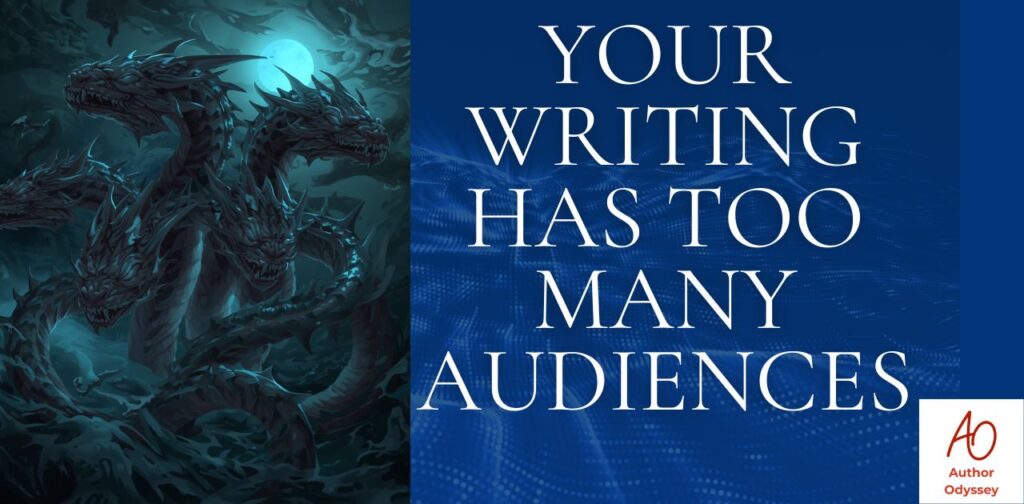
The Scatterstorm Hydra
At Author Odyssey, we sometimes describe this problem as the “Scatterstorm Hydra.”
Imagine a mythological creature, a hydra with multiple heads. It’s terrifying. Each head represents a different audience you are trying to serve:
The beginner
The expert
The reflective reader
The practical reader
The strategic thinker
The emotional seeker
Every audience arrives with different expectations, and as you try to satisfy each one your manuscript gets pulled apart in multiple directions. Instead of creating a unified reading experience, your writing fragments like shattered glass.
The problem is not your intelligence or your craft. The problem is divided focus.
Why Clear Direction Matters
Every strong nonfiction book has one clear path. That does not mean your ideas need to be simplistic, it means they need to feel coherent to the reader you are speaking to.
When readers cannot tell who the book is for, they struggle to trust the journey.
Stephen Covey Understood This
A great example of audience clarity is Stephen Covey. Instead of trying to force every audience into one book, he created variations designed for different readers.
Different books for different needs, different framing for different audiences. That clarity allowed each book to feel intentional and focused.
Nonfiction authors often believe narrowing their audience will limit their reach, but usually the opposite happens. Specificity creates connection.
The Solution: Choose One Reader
If your writing feels scattered, stop trying to manage all five heads of the hydra.
Choose one, one ideal reader, one emotional journey, one central problem, and one voice. This does not mean other people cannot enjoy the book. It means the book has a stable center.
The moment you become clear about who you are writing for, your decisions become easier:
What stories belong
What examples fit
What tone works
What should be removed
What depth is appropriate
Clarity eliminates unnecessary complexity.
How to Get Your Writing Back on Track
When nonfiction authors become stuck, overwhelmed, or scattered, the fastest solution is often not better editing. It is audience realignment.
Ask yourself:
Who is this truly for?
What problem are they trying to solve?
What emotional state are they in when they pick up this book?
What transformation are they seeking?
The clearer those answers become, the more focused your writing becomes, and suddenly the manuscript starts flowing again. Writing doesn’t become easier mechanically, but the direction becomes clearer psychologically.
Final Thoughts On Doing Too Much
Your writing does not need more audiences, it needs more focus.
Most Writers Try to Do Too Much (And It Shows) because they believe breadth creates value. But readers connect most deeply with writing that feels intentionally written for them.
So if your manuscript feels scattered, fragmented, or overloaded with competing ideas, it may not be a writing problem at all.
Your Writing Has Too Many Audiences, simply choose one reader and let the rest of the book align around them.
How defeating the hydra can affect your author journey:
Implementing the ideas discussed here can completely change the trajectory of your journey because it helps you move from scattered communication to intentional communication.
Many nonfiction authors struggle because they are trying to serve too many audiences at once. When you narrow your focus to one ideal reader, several things happen immediately:
Your writing becomes clearer and easier to structure.
Your tone becomes more consistent.
Readers feel understood and emotionally connected.
Editing becomes faster because you know what belongs and what does not.
Your message becomes stronger and more memorable.
Marketing your book becomes easier because you can clearly explain who the book is for.
Instead of writing a book that vaguely appeals to everyone, you begin creating a book that deeply resonates with someone specific. That is often the difference between a forgettable nonfiction book and one readers recommend to others.
3 Quick Actions to take when your writing has too many audiences
Write One Reader Profile
Take 5 minutes to describe your ideal reader in one paragraph.
Answer:
What are they struggling with?
What do they desperately want?
Why are they reading your book right now?
This instantly sharpens your writing focus.
Highlight Audience Shifts
Open one chapter and highlight every section where the tone or audience changes.
For example:
beginner → expert
practical → philosophical
casual → academic
You will quickly spot where your manuscript becomes fragmented.
Create a “Not For” List
Spend a few minutes writing down who your book is not for.
This sounds counterintuitive, but it creates enormous clarity. Strong nonfiction authors are often defined as much by who they exclude as who they include.
Recent Articles
Does My Manuscript Need More Revision? | When to Stop Editing Your Own! Book
October 15, 2026
No Comments
Wondering whether your nonfiction manuscript needs another round of revision? Learn how to recognise when more self-editing will genuinely strengthen your book—and when an outside
Choose the Right Editing Service | Which Level of Editing Does My Manuscript Need?
October 8, 2026
No Comments
Not sure what kind of editing your nonfiction book needs? Start with what feels off in your manuscript, and discover the right kind of editorial

Why Your Content Isn’t Working Together
October 1, 2026
No Comments
Learn how to build a Content Ecosystem From Your Expertise where your book, podcast, newsletter, workshops, and other content each have a clear purpose and